

Otolaryngology (Head & Neck Surgery)
A national leader
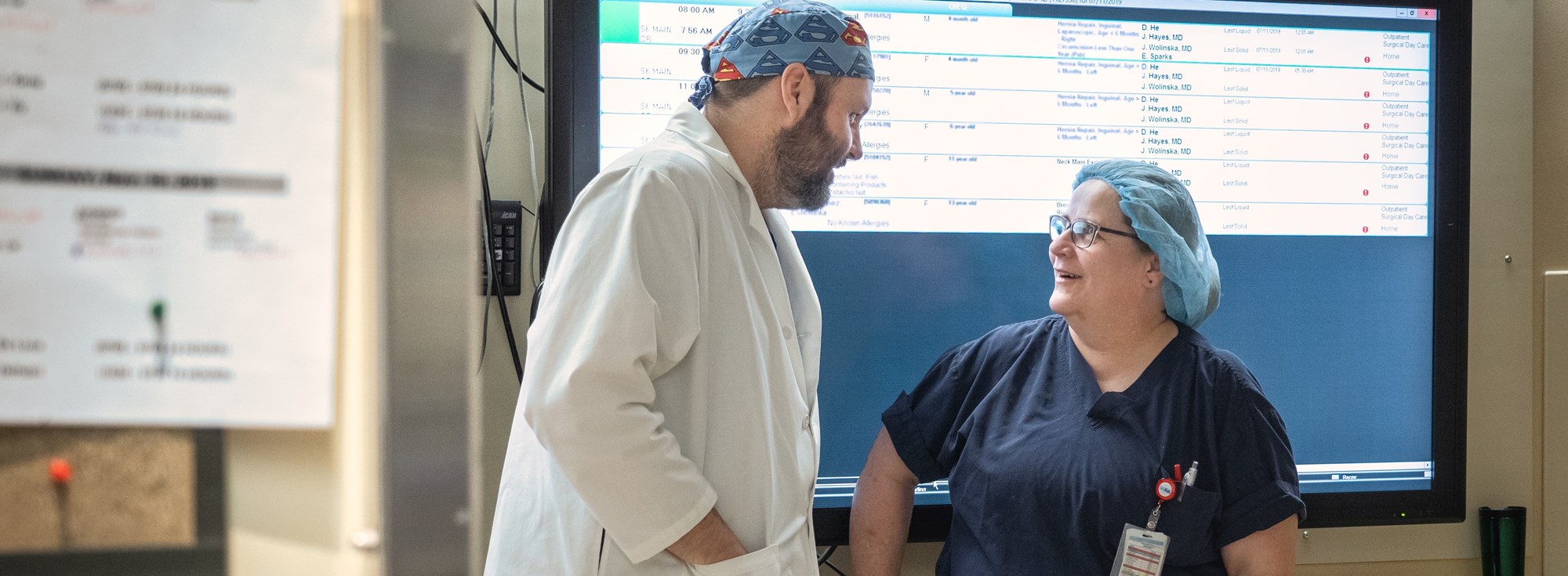
The Department of Otolaryngology – Head & Neck Surgery, under the direction of Dr. Blake Papsin, is the largest paediatric otolaryngology department in Canada.
Over 8,000 patients are seen in the Ear, Nose, and Throat (ENT) clinic annually, and the surgical case load is approximately 1,450 per year. Approximately 1,200 of these are major in nature involving all aspects of otolaryngology - head and neck surgery, such as complex airway cases, surgical rehabilitation of hearing loss through cochlear implantation and bone anchored hearing aids, external, middle and inner ear disorders, as well as endoscopic sinus surgery.
Patient care is multidisciplinary. Special areas of clinical expertise have developed over the years including voice and laryngeal function, laryngo-tracheal reconstruction, complex sleeping disordered breathing and vestibular dysfunction.
Educating the world
We are fully affiliated with the Department of Otolaryngology – Head & Neck Surgery, Faculty of Medicine at the University of Toronto. Our mission is in keeping with the faculty's own mission statement, which is to provide excellence and international leadership in all aspects of paediatric otolaryngology by teaching, undertaking research and patient care. Our Fellowship Program accepts candidates from all over the world.
Programs and services
Areas of clinical expertise
As an integral part of many multidisciplinary teams working in one of the most advanced children's hospitals in the world, the Otolaryngology - Head and Neck Surgery department is capable of diagnosing and treating children with any disorder affecting the head and neck, including:
- Neonatal airway
- Laryngotrachael reconstruction
- Complex cysts and sinuses
- Head and neck tumours
- Nasal septal surgery
- Cholesteatoma
- Cochlear Implant Program
Select programs, services and clinical functions are explained in detail below. Expand each section to read more.
When a child has a significant hearing loss, it can have a big impact on their ability to talk, listen, and learn. If a child is not able to hear well enough with hearing aids, a cochlear implant may be an option to help improve their hearing. A cochlear implant is an implantable, surgical device with an external sound processor that can help change lives for children with severe-to-profound hearing loss.
A leading program in North America
The Cochlear Implant Program at SickKids is one of the largest paediatric centres for cochlear implantation in North America. Our highly specialized team of surgeons, audiologists, speech-language pathologists, social workers and researchers work as a team to see if a child is a candidate for a cochlear implant. Once a child receives a cochlear implant, our experienced team continues to follow and support children throughout their school years until they turn 18.
Since 1990 we have implanted over 2000 children and our world-class surgeons have treated children from all around the world.
The team
The Cochlear Implant Team at SickKids is made up of professionals from many different specialties, including Otolaryngology, Audiology, Speech-Language Pathology, Social Work, Nursing, Genetics, and Research. The team works very closely together to provide the best care possible for children with cochlear implants.
Referrals
Parents can self-refer to the Cochlear Implant Program. To apply, please download and complete the Cochlear Implant Program Patient Questionnaire (PDF) and mail or fax the form to the Cochlear Implant Coordinator (contact information included in PDF).
The process
When a child has been identified with a severe-to-profound hearing loss, it can be a very difficult time for the family. Our highly experienced and compassionate team will meet with families shortly after their diagnosis to answer questions about the hearing loss, the implications on speech and language development, and to provide more information about cochlear implants.
Over the next few months, the child will go through an assessment process with many of the professionals on our team to see if a cochlear implant would be beneficial for the child. The child will have multiple hearing tests with the audiologists on the team to confirm the hearing loss, and our speech-language pathologist and aural rehabilitationists will help determine the child’s communication abilities. The child will also receive and MRI as part of the assessment process. Our team social worker will help support the family through this journey.
Once all of the necessary assessments have been completed, the team gets together to share findings and make a candidacy recommendation. If cochlear implantation has been recommended, the child is placed on the waiting list for surgery.
The cochlear implant surgery is performed by our surgeons and is usually a day surgery (an overnight stay is not usually needed). After 3-4 weeks, the cochlear implant(s) will be activated and then comes the most exciting and happiest part – when the child will be able to hear through the implant!
The child continues to be followed and supported by our Program until their 18th birthday.
Outside of Ontario?
For families living outside Ontario, please contact us for information on whether your child would be eligible for a cochlear implant at our centre.
International families can also check the International Patient Program page.
This centre specializes in voice disorders in children, and is headed by Paolo Campisi (Paediatric Otolaryngologist) and Laurie Russell (Speech Language Pathologist). This centre offers voice assessment which includes perceptual and acoustic evaluation of voice as well as endoscopy and/or videostroboscopy. The centre was originally known as the Paediatric Voice and Laryngeal Function Laboratory.
The DREAMS Clinic is a specialized clinic for the assessment and treatment of children and adolescents with complex sleep-disordered breathing. The experienced team includes respirologists/sleep physicians, otolaryngologists (head and neck surgeons), neurosurgeons, plastic surgeons, paediatric orthodontists, neuroradiologists, MRI technicians, anesthesiologists, a nurse practitioner and a respiratory therapist. We provide a multidisciplinary approach to managing complex obstructive sleep apnea, which may include surgical and non-surgical options.
The ENT Clinic provides multidisciplinary care for all types of otolaryngology cases, including complex airway cases; surgical rehabilitation of hearing loss through cochlear implantation and bone anchored hearing aids; external, middle and inner ear disorders; and endoscopic sinus surgery. Special areas of clinical expertise have developed over the years, including voice and laryngeal function, laryngo-tracheal reconstruction, and complex sleeping disordered breathing and vestibular dysfunction.
The Vertigo Clinic is part of the ENT Clinic, which provides multidisciplinary care for all types of otolaryngology cases, including complex airway cases; surgical rehabilitation of hearing loss through cochlear implantation and bone anchored hearing aids; external, middle and inner ear disorders; and endoscopic sinus surgery. Special areas of clinical expertise have developed over the years, including voice and laryngeal function, laryngo-tracheal reconstruction, and complex sleeping disordered breathing and vestibular dysfunction.
The ability to quickly assess and treat newborn airway problems is vital to a successful outcome. The causes of neonatal airway obstruction are varied and are unique to paediatrics. The approach involves first defining the level of obstruction (where is the lesion?), and next identifying the specific pathologic entity (what is the lesion?). The assessment begins at the nose and proceeds all the way to the the chest wall. Every attempt is made to treat the primary cause in order to avoid the need for neonatal tracheotomy.
|
Level of Obstruction |
Examples |
|---|---|
|
Nasal |
|
|
Craniofacial Anomalies |
|
|
Pharyngeal |
|
|
Cervical |
|
|
Laryngeal |
|
|
Tracheal |
|
|
Bronchial |
|
|
Pulmonary |
|
|
Chest wall (Mechanical / Neuromuscular) |
|
The paediatric airway has been and still is an area of considerable expertise and innovation at The Hospital for Sick Children.
The late Blair Fearon introduced the world to laryngotracheoplasty in children in the 1970's. He also popularized the use of the CO2 laser for the paediatric airway in Canada. National as well as international fellows, residents and colleagues benefited tremendously from his unrelenting perseverance with this most difficult clinical entity. Work has continued at the hospital expanding upon his ideas.
William Crysdale performed the first anterior-posterior cricoid split in North America in 1974, as well as gaining considerable experience in the use of laryngeal stents.
More recently, Vito Forte has introduced the use of autogenous laryngeal cartilage as an alternative to rib cartilage as the graft of choice for moderately severe subglottic stenosis in the neonatal period and young child. Also he has successfully applied the principles of cricotracheal resection in adults, to children with severe subglottic stenosis.
Another area of recent innovation, developed by Vito Forte and Robert M Filler (Division of Paediatric General Surgery) has been the clinical use of the Palmaz stent for children with severe tracheobronchomalacia or collapse of the post-tracheoplasty trachea.
Also, much effort has gone into prevention of laryngotracheal problems by developing protocols for the management of the intubated and the failure to extubate neonate.
Much effort has gone into single stage reconstruction of the larynx for subglottic stenosis as well as single stage repair of laryngeal clefts in order to avoid long-term tracheotomy.
For publications related to this topic, please go to Pubmed.
As an integral part of many multidisciplinary teams working in one of the most advanced children's hospitals in the world, the department is capable of diagnosing and treating children with any disorder affecting the head and neck.
Head and neck tumours are uncommon in children. Only in a paediatric tertiary care centre, such as The Hospital for Sick Children, can enough experience amass for the development of expertise in dealing with these complex problems. The surgical concepts and techniques developed for the treatment of head and neck tumours in adults can be safely applied to the child, but special consideration must be given to future growth and developmental issues. An example of such a situation would be in the treatment of juvenile nasopharyngeal angiofibroma where surgical removal is preferred over external beam radiation for tumours which are extracranial.
For any head and neck tumour, the implications of treatment must be considered very carefully. Decisions regarding treatment are usually made at a multidisciplinary tumour board. Each specialist gives input as to the efficacy and consequences of the treatment proposed. The final decision as to what treatment is decided upon is arrived at by consensus. Progress and changes in the treatment plan are also monitored via tumour board rounds. Only with all the child's caregivers involved in the decision making process, can the best possible result be achieved.
Nasal airway obstruction is common in children. The presentation may be dramatic (obstructive sleep apnea), life threatening (choanal atresia in a newborn), or subtle (long face syndrome seen in the teenager as a consequence of long-standing nasal airway obstruction). Deviation of the nasal septum may be the cause of significant nasal airway obstruction.
Various names for congenital cholesteatoma have been proposed over the years including primary cholesteatoma (fr. Greek.chole, bile + stear, tallow, suet), true or cholesteatoma verum, primary epidermoid and genuine cholesteatom well as margaritoma (fr. Gr.margarites, a pearl), steatoma and keratoma (fr. Gr. keratos, horn).
The diagnosis of congenital cholesteatoma has always presented some difficulty and controversy. In 1936, R.W.Teed demonstrated an epithelial thickening of ectodermal origin which developed in close relationship to the geniculate ganglion, at the dorsal end of the first pharyngeal cleft, medial to the neck of the malleus.
Under most circumstances this structure would be expected to atrophy and become normal middle ear endothelium. When this did not occur, its continued growth could give rise to what would later present as a cholesteatoma. H. P. House is generally credited with reporting the first bona fide case of congenital cholesteatoma of the middle ear behind an intact tympanic membrane in 1953.
Derlacki and Clemis can be credited with legitimizing congenital cholesteatoma. In 1965, they simplified the classification into a) petrous pyramid type, b) mastoid type and c) tympanic type. It is now generally accepted that congenital cholesteatoma does develop from a congenital epithelial rest in the middle ear and may present at any age from infancy to adulthood; although, once the disease has attained a large size or extended beyond the middle ear it can be impossible to to establish a congenital as opposed to an acquired etiology.
The typical patient presents with an asymptomatic discrete white lesion behind a currently intact tympanic membrane. There is no available history of significant trauma or major ear infection. The mastoid cell systems are most often symmetrically well-developed and aerated. Retraction pockets either of the attic or mesotympanum are not a feature and the Eustachian tube is apparently functional. These lesions are usually unilocular and restricted to the middle ear, presenting anterosuperiorly in the large majority of cases. When the diagnosis is early, ideally before three or four years of age, and the cholesteatoma confined to the anterosuperior quadrant of the middle ear one can expect curative removal and the preservation of normal hearing.





Key staff
Division Head:
Dr. Blake C. Papsin, Otolaryngologist-in-Chief
Professor, Department of Otolaryngology – Head and Neck Surgery
University of Toronto
Phone: 416-813-6558
Dr. Paolo Campisi, Otolaryngologist; Director – Centre for Paediatric Voice and Laryngeal Function (Voice Clinic); Professor, Department of Otolaryngology – Head and Neck Surgery, University of Toronto; Director, Postgraduate Education, University of Toronto. Phone: 416-813-6558
Dr. Sharon Cushing, Otolaryngologist; Director, Cochlear Implant Program; Associate Professor, Department of Otolaryngology – Head and Neck Surgery, University of Toronto. Phone: 416-813-6558.
Dr. Adrian James, Otolaryngologist; Professor, Department of Otolaryngology – Head and Neck Surgery, University of Toronto. Phone: 416-813-6558.
Dr. Evan Propst, Otolaryngologist; Fellowship Director, Residency Site Director and Undergraduate Medical Education Site Director, SickKids; Associate Professor, Department of Otolaryngology – Head and Neck Surgery, University of Toronto. Phone: 416-813-6558.
Dr. Jennifer Siu, Otolaryngologist; Assistant Professor, Department of Otolaryngology – Head and Neck Surgery University of Toronto. Phone: 416-813-6558.
Dr. Nikolaus Wolter, Otolaryngologist; Assistant Professor, Department of Otolaryngology – Head and Neck Surgery University of Toronto. Phone: 416-813-6558.

Publications
To review recent papers published by staff physicians, please visit the PubMed website and search by name under any of our staff Otolaryngologists:
- Dr. Blake Papsin
- Dr. Paolo Campisi
- Dr. Sharon Cushing
- Dr. Adrian James
- Dr. Evan Propst
- Dr. Jennifer Siu
- Dr. Nikolaus Wolter
Auditory Science Lab
The Auditory Science Lab carries out clinical and basic science research related to normal and abnormal hearing function. It is headed by Dr. Robert Harrison, senior scientist.
For more information, visit the Auditory Science Laboratory website.
The Department of Otolaryngology - Head & Neck Surgery is dedicated to a variety of educational programs and is affiliated with the University of Toronto.
Expand the sections below to learn about each educational offering, which includes information on eligibility, time commitments, objectives and more.
Even though many individuals completed informal fellowships in Paediatric Otolaryngology – Head & Neck Surgery at The Hospital for Sick Children since the early 1970s, it was not until 1986 that a formal fellowship was initiated. Since its inception, this world-renowned fellowship program has trained numerous paediatric otolaryngologists – head & neck surgeons who then returned back to their communities to treat the children with the highest level of care possible. The program is accredited by the Royal College of Physicians and Surgeons of Canada (RCPSC) and is recognized by the American Society of Pediatric Otolaryngology (ASPO) as being ACGME equivalent.
The Fellowship Program is one year of clinical duties with the option of an additional second year of research.
Foreign graduate eligibility requirements:
All clinical fellows require licensure by the College of Physicians and Surgeons of Ontario (CPSO), the body that regulates the practice of medicine in Ontario. All candidates must be recognized as a medical specialist in the jurisdiction where they have been practicing medicine prior to the clinical fellowship.
Some facts about our fellowship include:
-
- The fellowship was established in 1986.
- The fellowship's location is The Hospital for Sick Children (SickKids) in Toronto, Canada.
- The duration of fellowship is one clinical year with the option of an additional year.
- Two fellows are accepted per year.
- The required prior residency training is Otolaryngology - Head & Neck Surgery.
- The fellowship accepts foreign medical graduates.
- The United States Medical Licensing Examination (USMLE) is NOT required to pursue this fellowship. All applications MUST be made through the San Francisco Match. We abide by the deadlines posted on the SF Match website. Please do NOT send your curriculum vitae to us directly by email expressing your interest and requesting an interview.
Please visit the Post Graduate Medical Education Office website for detailed information.
The Hospital for Sick Children (SickKids)
Founded in 1875, SickKids is located in downtown Toronto, a cosmopolitan city of three million people (fourth largest city in North America – the Greater Toronto Area is home to 5.8 million people). It is a tertiary/quaternary referral centre with 330 inpatient beds. There are approximately 220,000 ambulatory clinic visits, 64,000 emergency visits and 12,000 operating room cases annually.
There are six full time pediatric otolaryngologists – head & neck surgeons covering 9,000 clinic visits and 1,500 tertiary care operating room cases annually. Routine surgical cases on healthy children are performed by other otolaryngologists at other hospitals within the Greater Toronto Area. A new 21-storey research tower (The Peter Gilgan Centre for Research and Learning) houses the Otolaryngology – Head & Neck Surgery Laboratory and Lab Animal Services.
Residents and fellows
The fellow / resident complement usually consists of two clinical fellows and three residents (first, third and fourth year). The fourth year resident runs the service with advice from the fellows. The residents rotate every three months. There are often medical students and foreign observers present on the service. A strong working relationship between the residents and the fellows is essential.
Fellowship type
Year 1: 80% clinical, 20% research
Year 2 (optional): Individualized for each fellow
Fellowship Director and Faculty
Our Fellowship Director is Dr. Nikolaus Wolter. Participating faculty include:
- Dr. Blake Papsin (Otolaryngologist-in-Chief)
- Dr. Paolo Campisi
- Dr. Evan Propst
- Dr. Adrian James
- Dr. Sharon Cushing
- Dr. Jennifer Siu
Objectives
- Maintain a collegial and collaborative working relationship with the chief resident(s) and other staff.
- Act as an advisor to the residents as they participate in ward rounds and see consultations from the Emergency Department and General Wards (not intensive care units).
- Lead the consultation service for the Intensive Care Units (Neonatal Intensive Care Unit, Paediatric Intensive Care Unit, Cardiac Critical Care Unit) and provide daily input to them regarding the patients our service has consulted on.
- Participate in all major surgical cases unique to the practice of paediatric otolaryngology – head & neck surgery.
- Participate in all surgical cases that evolve from consultations from the Intensive Care Units.
- Supervise appropriate operative lists during the final six months of training. The fellow will be supported in achieving these goals.
- Run a fellow’s clinic every one to two weeks (at the discretion of the fellowship director).
- Participate in special interest clinics (voice clinic, complex sleep disorders clinic, balance clinic, etc.).
- Attend teaching rounds (Wednesday morning teaching rounds, Friday morning university rounds, monthly journal club evenings).
- Prepare pathology rounds (once every 6 – 8 weeks) and morbidity and mortality rounds (once every 3 - 4 months).
- Develop a plan within the first month regarding a research project that can be completed longitudinally throughout the year. The fellow should strive to present this research at a meeting and submit a manuscript for publication. The fellow is encouraged to contact the Fellowship Director well before beginning the fellowship to discuss ideas and plan a topic so he/she can "hit the ground running."
- Participate in resident call coverage at least one weekday evening per week when necessary.
Additional features of the fellowship
-
- Fellows are expected to give 2 informal teaching sessions per month to residents on a topic of their choosing.
- Fellows are expected to present a research paper at the annual Department of Otolaryngology Percy Ireland Research Day and at a national/international conference.
- Fellows are encouraged to discuss any difficulties, conflicts or grievances with the Fellowship Director as they arise and at introductory, mid-rotation and final meetings.
- Clinical fellows must register with the University’s Post Graduate Medical Education Office. An Orientation Handbook with a timeline for registering can be downloaded at: http://www.pgme.utoronto.ca
- International trainees will undergo a 12 week Pre-Entry Assessment Program (PEAP) at which point a full CPSO license will be issued if deemed appropriate. US and Canadian trained fellows do not need to complete the PEAP and should obtain their full CPSO license prior to arriving so they may commence clinical duties immediately.
Salary and benefits
Annual Stipend/Salary: $98,566.96 CAD per year (includes stipend for backup call)
Additional Benefits:
-
- Fellows will be reimbursed for conferences where they are presenting a research project (at the discretion of the Otolaryngologist-in-Chief)
- CMPA malpractice insurance
- Health-care coverage
On call responsibilities
-
- Participate in resident call coverage at least one weekday evening per week when necessary.
- Additionally provide backup call to the PGY-1 resident.
- Additional days may be required when there is a shortage of residents.
Case mix
Due to the referral pattern of the hospital, the majority of surgical cases are at the tertiary/quaternary care level.
How to apply
The Fellowship application process is facilitated through the San Francisco Match (SFMatch) website. Requirements and instructions to apply are listed there. Internationally trained physicians are eligible.
If you have additional letters of reference, above and beyond the three (3) that have been submitted to SFMatch, please feel free to email those directly to us.
The deadline to apply for the Fellowship Program changes each year. Please verify on the SFMatch website.
If granted an interview, applicants will be asked to bring their surgical case log to the interview. The surgical case log should include the last three (3) years of residency and contain no patient-identifying data.
Main headings should be otologic, rhinologic, oral, airway, esophageal, and neck. The types of surgeries and number performed should then be listed under the appropriate category.
Contact information for applicants
Dr. Nikolaus Wolter
c/o Anne Rodriguez-Hall
Department of Otolaryngology – Head & Neck Surgery
6th floor, Burton Wing
555 University Avenue
Toronto, Ontario
M5G 1X8
Canada
Phone: 416-813-7654 ext. 428427. Email: anne.rodriguez-hall@sickkids.ca
Thank you for your interest in our program. We look forward to reviewing your application.
The Department of Otolaryngology – Head & Neck Surgery offers two-week Electives to undergraduate medical students and postgraduate medical residents.
Contact Anne Rodriguez-Hall, Administrative Coordinator (anne.rodriguez-hall@sickkids.ca) to discuss available dates. Electives are granted on a first-come, first-serve basis.
The Electives Office at the University of Toronto (U of T) supports:
- U of T MD students completing electives at U of T or other medical schools
- A visiting electives program for undergraduate students attending medical schools across Canada and the United States (US)
- A visiting international electives program for undergraduate students attending medical schools outside of Canada and the US
- A U of T MD Program student, contact electives.uoft@utoronto.ca
- A medical student from a Canadian or US medical school, contact medicine.electives@utoronto.ca
If you are a medical student from an International medical school, contact medicine.electives@utoronto.ca
As a postgraduate medical resident, you may register for an elective rotation at the University of Toronto in order to satisfy a specified part of the requirements of the ongoing residency training program in which you are enrolled at your home institution.
Visit the University of Toronto’s Postgraduate Medical Education Office website for more information regarding eligibility and application requirements.
Otolaryngology at SickKids offers two-week Observerships. Each year the department receives more requests for visitors than we are able to accommodate. Observerships are restricted to two-weeks to ensure this opportunity is available to as many learners as possible.
Contact Anne Rodriguez-Hall, Administrative Coordinator (anne.rodriguez-hall@sickkids.ca) to discuss available dates. Observerships are granted on a first-come, first-serve basis.
All international observership requests are facilitated centrally through the International Learner Program, contact ilp.requests@sickkids.ca with any questions regarding the International Learner Program.
For a complete list of upcoming Continuing Medical Education (CME) events offered by the Department of Paediatric Otolaryngology - Head and Neck Surgery at the University of Toronto, visit the Faculty of Medicine’s Continuing Professional Development website.
For a list of SickKids/University of Toronto Instruction workshops, please visit orlped.com.
Contact Otolaryngology
Phone: 416-813-6558
Fax: 416-813-5036
Address:
Department of Otolaryngology - Head and Neck Surgery
The Hospital for Sick Children (SickKids)
555 University Avenue
Room 6109, Burton Wing
Toronto, Ontario M5G 1X8
Clinical Staff
Faith Na, Mary-Elizabeth Vanderpost & Sabrina Fazio, Registered Nurses
Phone: 416-813-6452
Fax: 416-813-6496
Sade Martin, Clinic Flow Coordinator
Phone: 416-813-7654 ext. 227108
Administrative Staff
Fides Mulawin, Patient Information Clerk
Contact to book, reschedule or cancel clinic follow-up appointments
Phone: 416-813-6558, Option 1
Anna Worley, Patient Care Information Coordinator
Phone: 416-813-7654, ext. 202844
anna.worley@sickkids.ca
Suzanne Jones, Patient Information Coordinator, Referrals
Phone: 416-813-6558, Option 2
suzanne.jones@sickkids.ca
Dianne Struk, Surgical Administrative Coordinator for Dr. Blake Papsin, Dr. Sharon Cushing & Dr. Adrian James
Phone: 416-813-6558, Option 6
dianne.struk@sickkids.ca
Rebecca Yakimowski, Surgical Administrative Coordinator for Dr. Paolo Campisi & Dr. Alex Osborn
Phone: 416-813-6558, Option 7
rebecca.yakimowski@sickkids.ca
Emily Jamieson, Surgical Administrative Coordinator for Dr. Evan Propst
Phone: 416-813-6558, Option 8
emily.jamieson@sickkids.ca
Courtney Lascelle, Surgical Administrative Coordinator for Dr. Nikolaus Wolter & Dr. Jennifer Siu
Phone: 416-813-6558, Option 9
courtney.lascelle@sickkids.ca
Patricia Fuller, Administrative Coordinator, Cochlear Implant Program
Phone: 416-813-7259
patricia.fuller@sickkids.ca
Olga Vayner, Hearing Healthcare Coordinator
Phone: 416-813-5315
olga.vayner@sickkids.ca
Victoria Troisi, Social Worker
Phone: 416-813-7654, ext. 414941
victoria.troisi@sickkids.ca
For all educational inquiries, please contact:
Anne Rodriguez-Hall, Administrative Coordinator
Phone: 416-813-7654, ext. 428427
anne.rodriguez-hall@sickkids.ca
For departmental inquiries, please contact:
Valerie Simard, Clinical Manager
Phone: 416-813-4938
valerie.simard@sickkids.ca