 Go to Sitemap


Visual Electrophysiology Unit
The Visual Electrophysiology Unit (VEU) provides a comprehensive range of electrodiagnostic tests to help your child’s physician detect, diagnose, and monitor retinal or visual pathway disorders/diseases.
We perform a variety of tests to assess visual pathway function, from the retina to the occipital cortex. All tests are performed in accordance to International Society for Clinical Electrophysiology of Vision (ISCEV) standards - but we typically go beyond these standards. We also perform age-appropriate visual acuity test(s), contrast sensitivity measurements, and colour-vision assessments to diagnose colour deficiencies as part of our everyday care.
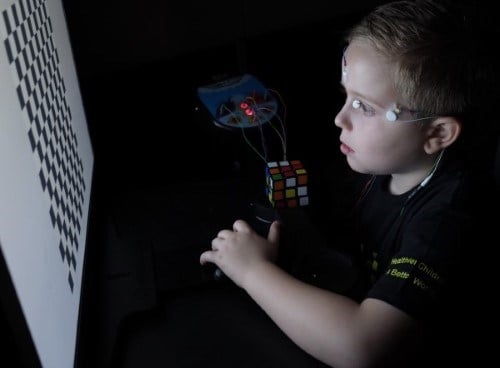
Paediatric visual electrophysiology tests for eye disorders and diseases
We’re committed to exceptional care and providing high-quality visual electrophysiology tests. We perform more than 800 procedures on children of all ages every year.
The VEU primarily serves patients within the Department of Ophthalmology and Vision Sciences, including patients from community ophthalmologists and optometrists in the GTA. We are also a primary referral centre for families across Ontario, and for some families across Canada and the USA. Our expertise and high standards of testing ensure your child is cared for while we assess visual function, so that they can continue to receive the best clinical care.
Programs and services
The VEU offers a variety of specialized tests that identify and measure visual function, diagnose for visual disorders, and monitor changes over time.
These tests are highly technical, specialized, and could take anywhere from 30 minutes to one hour. We strive for a positive test-experience while doing our best to get reliable, quality results. Staff do their best to communicate testing procedures, optimize your time, and tailor tests to accommodate your child’s needs.
All tests measure functional activity in your visual system to different types of stimuli (i.e., flashes, patterns). A combination of tests allows us to record and understand different parts of the visual pathway. Because of how specialized these tests are, some tests require more cooperation for accurate results and diagnosis.
Check out the VEU’s programs and services below for more details.
An electroretinogram (ERG) measures the electrical response from the retina to different types of stimulation. To perform the test, we need to use eye-electrodes to measure the electrical signals from the retina. There are different types of ERGs.
Full-field ERG (ff-ERG)
- The full-field ERG is the most common test of overall retinal function. An electrode placed on the eye measures responses from the retina to flashes of light, under dark- and light-adapted conditions to assess the function of rods and cones, respectively.
- Because the measurements are taken from the eye itself, this test can be performed awake (typically six years and older) or under sedation/general anesthesia.
- The test takes about 40 minutes. For accuracy in measurement, the pupils are dilated, and patients are encouraged not to blink or squint during the flashes. Contact lenses must be removed due to the use of eye-electrodes.
Multi-focal ERG (mfERG)
- The mfERG helps to assess cone function in the central retina under normal lighting conditions, but requires pupil dilation. An electrode placed on the eye measures the response from your cones to a large honeycomb pattern displayed on a screen. The pattern honeycombs quickly change between black/white during the test. This allows us to calculate how the cones from the central retina are functioning.
- The test takes about 15 minutes. For accuracy in measurement, the pupils are dilated, and patients are encouraged not to blink or squint during the recording.
Pattern ERG (pERG)
- The PERG measures the overall electrical response from the central retina, with your best vision. An electrode placed on the eye measures the response from the central retinal cones and ganglion cells, while the eyes are stimulated by a checkerboard pattern from a screen.
- The test takes about 20 minutes. For accuracy in measurement, glasses must be worn if used, and there should be minimal blinking and good focus. Contact lenses cannot be worn for this test.
Hand-held ERG
- The hand-held ERG is a quick screening tool to measure overall retinal function and is useful in very young children or patients with co-morbidities who cannot undergo sedation or anesthesia. For this test, an electrode placed on the lower eye-lid measures responses from the retina to flashes of light under dark- and light-adapted conditions. The hand-held ERG can provide general information on rod and cone system function. Please note that the hand-held ERG is not as in-depth or sensitive as the full-field ERG, and each eye is tested separately.
- The test takes about one hour. For any measurement to take place, the eyes must be open enough for the device to track the pupil.
The EOG assesses the function of a specific layer of the retina, the retinal pigment epithelium (RPE). The EOG measures the RPE function using electrodes placed at the inner and outer corner of each eye. For this test, patients are required to make quick eye-movements (left to right) between two lights, over time in the dark (15 minutes) and then in the light (15 minutes). The measurements are taken during the eye-movements.
The duration of the test itself is approximately 40 minutes. For accuracy in measurement, the pupils are dilated, the patient’s head must be very still and straight, and the eye movements must be quick between the two lights. Patents are encouraged not to squint or make other eye movements during the recordings.
A VEP measures how a specific stimulus (patterns or flashes) is processed by the visual cortex of the brain, with your best vision. The VEP response relies all parts of the visual pathway, from the front of the eye to the brain but is primarily used to measures optic nerve/pathway function. The signal is measured at the visual cortex using electrodes placed on the back of the scalp.
There are multiple types of VEP protocols offered, which are tailored to assess specific parts of the visual pathway based on patient ability and cooperation.
- Flash stimulus – uses a bright flash to measure overall visual potential (the ability to see light)
- Pattern reversal stimulus – uses checkerboard pattern of various sizes to measure optic nerve or pathway function
- Pattern appearance stimulus – uses checkerboard pattern of various sizes and/or contrast to objectively measure visual function and ability
- Multi-channel testing– uses checkerboard and flash stimuli with multiple electrodes across the back of the scalp to assess for albinism.
The duration of the test itself ranges from 10 to 20 minutes. For accuracy in measurement, the patient must be awake, looking towards the screen with good focus, and have the best possible visual acuity. Glasses or contact lenses must be worn if used for vision. Parental support and encouragement are required for young children.
The FST estimates the dimmest possible blue, red, and white flash of light that can be seen by patients with underlying retinal conditions. The FST relies on patient feedback to make this calculation. For this, patients are dilated and dark-adapted for 40 minutes before testing. During the test, patients must report if they see or do not see flashes of light using buttons until a reliable minim level of detection can be measured for each colour. No electrodes are used for this test.
The duration of the test itself is approximately 1.5 hours. For accuracy in measurement, the patient is tested in complete darkness, must be alert at the time of testing, and respond to every flash. Each eye is tested separately and each colour is tested at least two times.
Color vision is the ability to see different wavelengths of light and helps us assess function of central retina and optic nerve/pathway. Different colour vision testing measures the type and extent of colour blindness in a patient.
There are 3 common types of colour vision tests used in the VEU.
Hardy-Rand and Ritter (HRR)
- A standard colour vision test that measures the degree of red-green and blue-yellow colour-vision.
- Patients are required to name the shapes that stands out on a page of dots and the colour of these shapes.
D-15 (Farnsworth and Lanthony)
- D15 tests require patients to arrange 15 coloured discs into a box starting from a specific colour. The discs have to be arranged so the colours blend from one disc to the next as smoothly as possible, like a rainbow.
- How the discs are arranged measures the degree of red-green, and blue-yellow colour vision.
Mollon-Reffin “Miminal” Vision Test
- Uses patient’s judgement of colours to measure the degree of red-green and blue-yellow colour-vision.
- Patients are required to pick out a stand-out colour disc from a group of discs. The lightest coloured disc that can be picked-out reveals your level of red-green and blue-yellow colour-vision. This is a fun and easy test to do in younger children.
Prepare for a visit to SickKids’ VEU
To prepare for a visit and for more information, learn more about each of our tests below.
If you’re a provider and need more information on VEU services, please contact us via email visualelectrophysiology.unit@sickkids.ca.
Volunteer opportunities
Interested in participating in testing, or being involved in visual electrophysiology? Contact us directly.
Fellowships and training opportunities
This is a one-year program offered through the University of Toronto and Visual Electrophysiology program. Prospective trainees are required to understand the principles of visual electrophysiology and develop skills in clinical interpretation. Weekly training sessions are included year-round to establish a thorough understanding of electrophysiology.
Two-week observerships are available for practicing ophthalmologists with an interest in electrophysiology and electrophysiologists. These observerships are tailored to individual needs. We will work with you to enhance your knowledge and build experience in visual electrophysiology testing and interpretation.
If you’re interested in events related to visual electrophysiology, visit the International Society for Clinical Electrophysiology of Vision site for dates in 2021.
Research
Current ongoing research within the VEU include research on:
- Electrophysiology testing in subjects undergoing gene therapy
- Identifying novel genotype-phenotype correlations in inherited rential dystrophies
- Implementing personalized testing protocols for Precision Child Health
Our team
Our staff are well trained and experienced in visual electrophysiology, and certified members of the International Joint Commission on Allied Health Personnel in Ophthalmology (iJCAHPO) and the International Society for Clinical Electrophysiology of Vision (ISCEV). They are dedicated to providing personalized testing and care, and accurate test results to your physician.

- Ajoy Vincent – Medical director of the VEU & Staff Ophthalmologist (Ocular Genetics Program)
- Anupreet Tumber – Visual Electrophysiology Technologist, COA, M.Sc.
- Winnie Chou – Visual Electrophysiology Technician, RPN
Contact us
Email: visualelectrophysiology.unit@sickkids.ca
Phone: 416-813-6133
Location: Main Floor, Burton Wing, M293 (Eye Clinic)
Address
The Department of Ophthalmology and Vision Sciences
The Hospital for Sick Children (SickKids)
Main Floor, Burton Wing
555 University Avenue
Toronto, Ontario M5G 1X8