


WAGS: Wonderful Alternatives to General Anesthesia & Sedation

We understand that coming for an MRI can feel unfamiliar and sometimes a little overwhelming. New sounds, new spaces, the need to lie still, and sometimes being asked to hold your breath for short periods, can make the experience feel hard at first. That’s why our WAGS program was created, to gently guide children and families through what will happen, step by step, in a calm and reassuring way. Using age-appropriate explanations, play, and simple coping strategies, WAGS helps make the MRI feel more predictable, manageable, and less scary, and reduces the need for sedation and general anesthesia.
During an MRI scan, it is important for patients to stay still so the scanner can capture clear images. By using strategies to help patients remain calm and comfortable, we can minimize movement and improve image quality.
Patients, parents and caregivers are welcome to meet with our Child Life Specialist before their MRI appointment. During this visit, you can receive educational resources, experience a virtual reality MRI simulation, or access other support services tailored to your needs. Please note, accessing this service may require an additional visit to the MRI department depending on supports required.

Our MRI environment
Creating the right physical environment through the use of light and colour can help alleviate anxiety in patients undergoing MRI. Beginning with the first steps into the corridors of the MRI suites, all the way into the scan rooms, bright pictures and stimulating lighting can benefit older children especially as they navigate their MRI journey. Pictures of colorful characters on walls, such as forest friends peeping out from lush foliage or space-age installations, can be powerful distractors for paediatric patients. These can improve their chances of completing their scan without sedation or general anesthesia, alone or in conjunction with a range of non-sedation strategies.
For safety and comfort purposes, only one parent or caregiver may accompany the patient into the MRI room.

Child Life Specialists
Child Life Specialists are trained professionals with expertise in helping children and families cope with stressful events by using evidence-based interventions such as therapeutic and medical play, preparation, education and distraction techniques to help alleviate anxiety for children and youth.
All patients at SickKids can request support from a Child Life Specialist.
With an innovative and fun approach, Child Life Specialists aim to improve patient and family care, satisfaction, and overall hospital experience. This program is designed to familiarize patients with the sights and sounds of an MRI and to explain the step-by-step process of what they can expect to do during their appointment. By providing clear, honest, and developmentally appropriate explanations, Child Life Specialists empower patients to cope more effectively, leading to a more positive overall experience.
Recognizing that every child responds differently to medical encounters, our specialists assess each patient’s unique needs and create individualized coping plans. Whether working independently or alongside other non-sedation strategies, Child Life Specialists offer supportive alternatives to general anesthesia for children undergoing MRI scans.
Child Life Specialists can provide:
- Education and preparation: Through an interactive and visual approach, child life educates patients by using a tablet, virtual reality or a mock MRI table with a cloth doll to help patients gain a better understanding of their MRI. Developmentally appropriate explanations are used.
- Distraction techniques: For some cases, a patient may need contrast (a liquid dye sometimes referred to as “picture water”) that helps to highlight a certain part of the body to get a clearer picture, which means an IV is needed. Child life offers coping techniques to make this process quicker and more positive such as guided imagery, breathing techniques, playing fun games like "I-spy" and listening to music. Additionally, techniques to reduce pain can be offered such as numbing cream or freezing spray applied to the skin before an IV is inserted.
- Coping skills discussion and practice: Child life can provide a coping plan and coach your child through their MRI scan to help keep them calm and still. This might entail practicing staying still beforehand, practicing positive-self talk, guided imagery and deep breathing.
- Emotional and family support: Child life will spend the time to build rapport, understand the patient and parents' needs and advocate their concerns to the rest of the healthcare team to ensure that the child or adolescent is comfortable throughout their appointment.
Child Life Specialist Clinic
We offer a Child Life Specialist Clinic for families who would like extra support before their child’s MRI appointment. Families can book a clinic visit ahead of time so their child can meet with a Child Life Specialist and learn what to expect in a way that is easy to understand and tailored to their needs.
During the visit, we may use tools such as virtual reality or an MRI simulation to help your child practice what the MRI experience will be like. This can help reduce anxiety, build confidence, and support a smoother MRI appointment.
Families are encouraged to ask questions and share any concerns so we can work together to help create a positive experience for your child.
How do I request a Child Life Specialist for my infant/child when they need to have an MRI?
There are a few ways to request Child Life support:
- Your referring provider can note the request on the MRI requisition or contact the MRI scheduling team directly.
- Parents and caregivers can request Child Life support when the MRI team calls to book the appointment, or by calling the MRI scheduling team during business hours.
- Parents and caregivers may also request a visit to the Child Life Specialist Clinic before the MRI appointment to help prepare their child in advance.
- The MRI scheduling team or radiologist may also suggest Child Life support after reviewing your child’s referral.
What happens next?
An MRI nurse or a Child Life Specialist will review the request to determine if your child is likely to benefit from Child Life support. This assessment considers your child’s age, development, the type and length of the MRI scan, and whether general anaesthesia may still be required.
If Child Life support is appropriate, the MRI scheduling team will coordinate the appointment with a Child Life Specialist. If requested, they may also arrange a clinic visit ahead of the MRI to help your child prepare. Timing will depend on how soon the scan is needed, your availability, and Child Life team availability.
Please note: Requesting Child Life support or a clinic visit will not impact the scheduling timelines of your child’s MRI appointment.
"To be able to see and talk to a Child Life Specialist every visit, every blood test, finger poke and especially for each and every MRI is truly support like no other. From personal experience, one of the hardest things to go through was an MRI. Having to stay still and try to block out the noise and focus on a distraction, sometimes I was lucky to have child life there as my distraction. That is the magic of Child Life, you can be having a conversation and a 45-minute scan is over in an instant. ...not only do they bring support when patients need it, they put a smile on the face of kids and the families that have to bear witness to the difficulties patients face on a daily basis. I wish I could thank all Child Life Specialists individually.”

Movie and TV System
To help make MRI scans easier and more comfortable, children can watch their favourite movie or TV shows during the scan. Using a special mirror system and headphones, your child can relax and enjoy a show from a streaming service (e.g. Netflix, Disney+ or YouTube) while the MRI takes place. This friendly distraction helps kids feel more at ease and makes the experience less stressful.
Available anytime upon request.
This approach is most often used for children over the age of 3½. It can be used along with support from a Child Life Specialist, MRI practice sessions, or medication if needed. Audiovisual equipment (like movies or music) is available in all MRI areas and does not need to be arranged ahead of time.
How do I request the movie and tv system for my child when they need to have an MRI?
Simply ask your MRI technologist to set up the movie and TV show system before your exam begins.
Feed and sleep
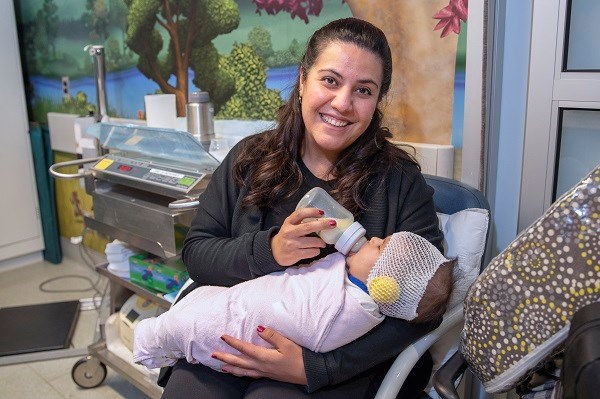
The "Feed and Sleep" or “Feed and Swaddle” technique is used for newborns and infants under 6 months of age for 30–90-minute MRI scans without sedation or general anesthesia. The goal is to feed and bundle the baby to fall into a natural sleep (to minimize movements and prevent blurring of MRI images).
Who is eligible?
Infants under six months of age are eligible.
Who is not eligible?
Infants over the age of six months or infants with feeding problems (e.g. severe gastroesophageal reflux) are not eligible.
Please note: While we do our best to keep appointments on time, delays can occasionally occur in a hospital setting. Emergency or urgent patients may need immediate access to the scanner, which can impact scheduled appointments, including feed and sleep studies. If this happens, our team will keep you informed and do everything possible to minimize wait times. Thank you for your patience and understanding.
Instructions for parents before MRI scan:
- Arrive one hour prior to MRI scan time
- Withhold one feed from baby before coming to MRI department (arrive hungry)
- Keep baby awake for three to four hours before the MRI (arrive tired)
On arrival for MRI:
- Fill out the MRI screening form
- Tell the nurse or technologist how long it typically takes to feed your baby
- Change your baby into non-metallic hospital clothing
- Change diaper if needed
- Your baby’s height and weight will be measured
- Your baby may require an IV to be inserted for contrast enhanced images
Getting ready for MRI scan:
- Small cushions or cloths are placed between baby's legs and between their arms and body, so they don't touch
- Baby is swaddled in a baby blanket and placed in an MRI-compatible immobilizer
To encourage sleeping during MRI scan:
- Room lights are kept dim
- Baby is given a large feed immediately before the scan
- Ear plugs and earmuffs are used to reduce noise
- Baby pacifier and/or sucrose may be used if baby wakes up
The feed and sleep technique does not always work. If that happens, sometimes the patient is rebooked to try this technique again on another day, or instead the patient is booked for MRI using general anesthesia.
How do I request feed and sleep for my baby when they need to have an MRI?
There are a few ways to do this:
- Your referring provider can note the request on the MRI form or contact the MRI scheduling team.
- Parents and caregivers can request the Feed and Sleep technique when the MRI team calls to book the appointment, or by calling the MRI scheduling team during business hours.
- The MRI scheduling team or radiologist may also suggest Feed and Sleep after reviewing your child’s request.
What happens next?
Our MRI nurse will review the request to see if your baby is eligible for the feed and sleep technique. This is based on your infant's age and development, the type and length of the MRI scan requested, and other information that might mean a general anesthetic is still needed.
"My son was born with a very serious heart condition and at a young age required numerous medical interventions. One of these interventions required him to have more than one MRI throughout the course of his hospital stay. There were times when a feed and sleep method was used, and although it may have taken a longer time (as my son was at a young age), the desire not to give him sedation medication was a preferred option for me. Especially given the fact that my son was already on quite a few medications, I found that the feed and sleep method was less invasive and allowed my child's body to naturally adjust to the upcoming procedure. My experience with the feed and sleep method was a positive one and I was glad that the staff showed patience and care before, during and after the MRI scan.”
Therapy dogs
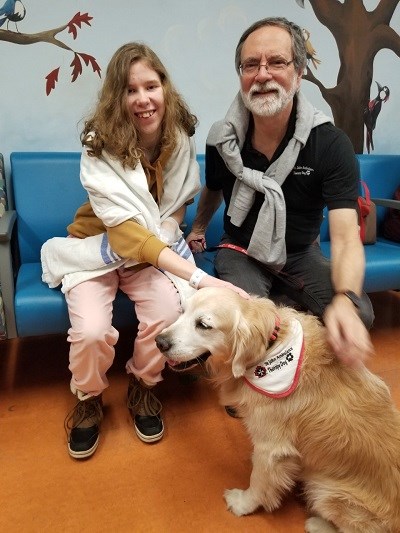
Therapy dogs offer comfort and emotional support to children before and during their MRI scan. This helps them feel more at ease and better able to remain still. Spending time with therapy dogs may even help some children avoid general anesthesia. These therapy dogs, and their handlers, are members of the SickKids PAWS Program.
Available upon request on certain weekday mornings.
Who is eligible?
Patients over the age of 3½ years are eligible.
Who is not eligible?
Patients under the age of 3½ years are not eligible. Patients with the following conditions or circumstances are also not eligible:
- Cerebral palsy
- Immediate post-operative (especially if neurosurgery)
- If the scan duration exceeds 90 minutes, the dog may be present for only part of the examination.
- MRSA, VRE and/or CPE carrier or infection
Upon arriving in the MRI department and after completing the standard registration and screening process, the patient and their parents/caregivers meet the therapy dog team – the dog and their handler – in the waiting room.
The interaction with the therapy dog includes the patient sitting near the dog, petting it and engaging in low-level play under the supervision of the handler. The handler keeps the dog on a loose leash at all times, attends to the dog's needs and can answer any questions. They use the dog to reassure the child about the upcoming scan – such as placing a pair of "mutt muffs" (headphones used to protect a dog's hearing in small aircraft) on the dog as a way of explaining to the patient that they will also be wearing ear plugs and headphones.
The therapy dog stays with your child in the MRI preparation area, including during IV placement if needed, and then goes with your child into the MRI scan room while they are getting settled on the MRI table. The dog gets onto the table first, and then your child follows.
Once your child is positioned in the scanner, the therapy dog waits in the MRI control room during the scan. The dog may come back into the scan room between parts of the scan if the MRI technologist feels it will help your child stay calm. During all interactions, the handler encourages your child to hold the dog’s leash.
Before the MRI, your child will spend about 20 to 60 minutes with the therapy dog. They may also have some time with the dog during and after the scan, depending on the situation. After the MRI is finished, your child will always get one more visit with the therapy dog outside the scan room, with time for photos and a final cuddle.
How do I request a therapy dog for my child when they need to have an MRI?
There are a few ways to do this:
- Your referring provider can note the request on the MRI form or contact the MRI scheduling team.
- Parents and caregivers can request support from a therapy dog when the MRI team calls to book the appointment, or by calling the MRI scheduling team during business hours.
- The MRI scheduling team or radiologist may also suggest therapy dog support after reviewing your child’s request.
What happens next?
Our MRI nurse or Child Life Specialist will review the request to see if your child is likely to benefit from a therapy dog. This is based on your child's age and development, the type and length of the MRI scan requested, and other information that might mean a general anesthetic is still needed.
If it’s decided that a therapy dog may help your child during their MRI, the MRI scheduling team will work to book an appointment during regular business hours and coordinate with one of our therapy dog teams. The appointment time will depend on how soon the scan is needed, your availability, and the availability of the therapy dog team.
"Thank you for organizing the therapy dog for the MRE... It was incredible to see R's interaction and response to the dog. I firmly believe she is the reason R was able to complete the test. My older three boys have now decided they will do some fundraising for more therapy dogs.”

MRI Simulation/Virtual Reality (VR)
At SickKids, we offer innovative MRI simulation experiences to help patients prepare for their scans.
Who is eligible?
Patients over the age of 3½ years are eligible. Eligibility may vary based on individual circumstances.
Who is not eligible?
- Patients under the age of 3½ are not eligible.
- Patients with the following conditions or circumstances are also not eligible:
- Infectious disease
- History of seizures
- Balance disorders
- Nausea
- Head lice
- Immediate postop neurosurgery
Our virtual reality (VR) headset uses interactive games to simulate the MRI process, teaching children what to expect and allowing them to practice lying still, an important skill for a successful scan. The VR headset can also provide distraction and comfort during procedures such as IV (intravenous) insertion.
In addition to VR technology, we use toy models of MRI scanners to familiarize patients with the MRI environment, making the experience less intimidating and more engaging for children and their families.
How do I request MRI Simulation/VR for my child when they need to have an MRI?
There are a few ways to do this:
- Your referring provider can note the request on the MRI form or contact the MRI scheduling team.
- Parents and caregivers can request MRI simulation/VR when the MRI team calls to book the appointment, or by calling the MRI scheduling team during business hours.
- The MRI scheduling team or radiologist may also suggest MRI simulation/VR after reviewing your child’s request.
What happens next?
Our MRI nurse or Child Life Specialist will review the request to see if your child is likely to benefit from MRI simulation/VR. This is based on your child's age and development, the type and length of the MRI scan requested, and other information that might mean a general anesthetic is still needed.
If it's determined MRI simulation/VR may help with your child's MRI scan - the MRI scheduling team, MRI nurse or Child Life Specialist will book a session with you and your child before your planned MRI exam to complete the simulation.
Please note, requesting MRI simulation/VR support will not impact the scheduling timelines of your child’s appointment.
IV Coping Strategies
There are several different strategies that can be used to help your child cope when they are getting an IV.
Available upon request.
Some strategies require a Child Life Specialist, who is available Monday to Friday, 8:30 a.m. to 4:30 p.m.
These strategies can help lessen anxiety and help with pain management. They can also promote a sense of control by offering the child choices. These strategies include:
- Distraction e.g. tablet, fidgets, bubble wand, virtual reality, etc. (CLS required)
- Sensory toys (CLS required)
- Guided imagery (CLS required)
- Comfort holds
- Numbing Cream
- Buzzy (needle and pain relief toy)
- Deep breathing
How do I request IV coping strategies for my child when they need to have an MRI?
Certain strategies require support from a Child Life Specialist, which will need to be requested in advanced.
Parents and caregivers may request IV support and specific strategies, when our MRI scheduling team contacts you to book the scan, or by calling the MRI scheduling team during business hours.

Natural sleep
Natural sleep MRI is completed while your child sleeps naturally, without sedation or general anaesthesia. Families receive preparation instructions to help their child fall asleep and remain asleep during the scan.
For children aged between 18 months and 5 years, although not always successful, it is sometimes possible to do the MRI scan by scheduling it in the afternoon to coincide with nap time, or evening to coincide with bedtime.
For a natural sleep MRI, the child is kept awake longer than usual before the appointment and may have their nap schedule adjusted so they are very tired. When they arrive, the room is kept quiet, dim, and calm. Parents can feed, rock, or comfort their child until they fall asleep, just like at home.
Once the child is in a deep sleep, they are carefully moved onto the MRI bed and the scan begins. Because MRI is noisy, soft ear protection is used, but the child continues sleeping. Staff closely monitor the child the entire time.
There are a few ways to do this:
- Your referring doctor can contact our MRI scheduling team or write this on the MRI request.
- Parents/caregivers can ask our MRI scheduling team when they contact you about the date and time of the scan or you can contact them at any time during business hours.
- Our MRI scheduling team and radiologists may decide it might be a good option for your child when they review the request.
What happens next?
Our MRI booking team or Child Life Specialist will review the request to see if your child is eligible for natural sleep during MRI. This is based on your child's age and development, the type and length of the MRI scan requested, and other information that might mean a general anesthetic is still needed.
If it's determined natural sleep may help with your child's MRI scan - the MRI scheduling team will find a time to book your child's scan, coordinating this with one of our Child Life Specialists.
Resources for health-care providers
- Strategies to perform magnetic resonance imaging in infants and young children without sedation Harrington SG et al. (2021) Pediatric Radiology doi: 10.1007/s00247-021-05062-3
- Safety challenges related to the use of sedation and general anesthesia in pediatric patients undergoing magnetic resonance imaging examinations Artunduaga M et al. (2021) Pediatric Radiology doi: 10.1007/s00247-021-05044-5
- Invited Commentary: Reducing Sedation and Anesthesia in Pediatric Patients at MRI Greer MC, Vasanawala SS (2020) Radiographics. doi: 10.1148/rg.2020190211.
- Easing anxiety in preparation for pediatric magnetic resonance imaging: a pilot study using animal-assisted therapy Perez MM et al. (2019) Pediatric Radiology doi: 10.1007/s00247-019-04407-3
- Cardiovascular MRI without sedation or general anesthesia using a feed-and-sleep technique in neonates and infants Windram J et al. (2012) Pediatric Radiology doi: 10.1007/s00247-011-2219-8
- Mock MRI: reducing the need for anaesthesia in children Carter AJ et al. (2010) Pediatric Radiology doi: 10.1007/s00247-010-1554-5
- Techniques for minimizing sedation in pediatric MRI Dong SZ, Zhu M, Bulas D (2019) J Magn Reson Imaging doi: 10.1002/jmri.26703
- Strategies to minimize sedation in pediatric body magnetic resonance imaging Jaimes C, Gee MS (2016) Pediatric Radiology doi: 10.1007/s00247-016-3613-z
- Interventions to reduce anxiety, distress and the need for sedation in adult patients undergoing magnetic resonance imaging: a systematic review Munn Z, Jordan Z (2013) Journal of Radiology Nursing Volume 32 (2)
- The impact of preparation and support procedures for children with sickle cell disease undergoing MRI Cejda KR et al. (2012) Pediatric Radiology doi:10.1007/s00247-012-2422-2
- Paediatric MRI under sedation: is it necessary? What is the evidence for the alternatives? Edwards AD, Arthurs OJ (2011) Pediatric Radiology doi: 10.1007/s00247-011-2147-7
- MRI techniques to decrease imaging times in children Kozak BM et al. (2020) Radiographics doi: 10.1148/rg.2020190112
Contact Us
To inquire about booking an MRI using WAGS options, please contact our MRI Scheduling Team during business hours.
MRI Scheduling Team
Phone: 416-813-5774, option #4 (Monday-Friday 8:30am-4:30pm).
General inquiries
Mary-Louise Greer
Founder, WAGS Program
Body MRI Co-Section Head
Department of Diagnostic & Interventional Radiology