

Powering precision: How next-gen computing is fueling scientific discovery at SickKids
Summary:
Modernizing SickKids’ research infrastructure is enabling faster, innovative, and more secure research at SickKids and beyond.
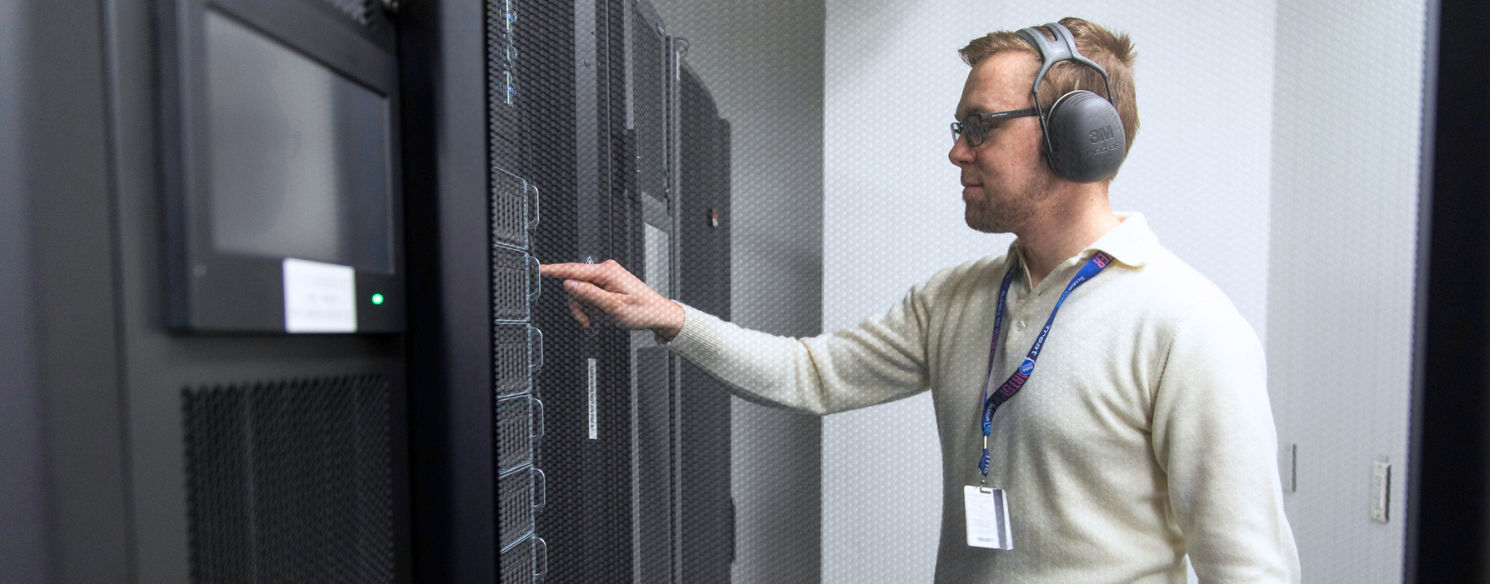
The next wave of discovery in genomics, artificial intelligence (AI) and paediatric research is taking off at The Hospital for Sick Children (SickKids) Research Institute, thanks to a major infrastructure transformation in its data centre.
Decoding the human genome, training AI to detect heart anomalies in infants, and simulating protein structures to design new therapies are scientific challenges that require significant computational resources.
Among the scientists tackling these types of challenges is Dr. Michał Koziarski, a Scientist in the Molecular Medicine program who is creating machine learning-driven pipelines for drug discovery.
“My lab is developing algorithms that can better predict the properties of small molecules and help other researchers identify which of these molecules could more effectively treat health conditions like childhood cancer,” explains Koziarski, who joined SickKids this past year.
“Because of the type and amount of data we analyze, including imaging, we use a lot of computational power that requires dedicated infrastructure and expertise.”
Over an 18-month period, supported by the SickKids Foundation, the SickKids Research Institute upgraded its technology infrastructure to better support high-performance computing (HPC), virtual server infrastructure, and provide scalable storage and data protection to over 3,000 researchers and clinicians. The upgrades are part of a suite of facilities and resources at SickKids that provide specialized, in-house support for SickKids scientists, with select services available to the larger research community, contributing to a unique research ecosystem that allows science to thrive.
For scientists like Koziarski, this means access to computational power that can increase throughput and capacity, reduce wait times, and hopefully help researchers find new and effective treatments for patients sooner.
“In-house access to computational power is what makes our research possible,” says Koziarski.

Large consortiums and nation-wide research initiatives increasingly also depend on robust computing power and secure data storage, capabilities enhanced by this recent transformation.
In a major undertaking to sequence over 100,000 genomes in the next three years and advance precision health across Canada, Genome Canada awarded nearly $12 million to SickKids-led projects through the Canadian Precision Health Initiative. Approximately half of the sequencing and analysis for what will be Canada’s largest collection of human genomic data will take place at SickKids at The Centre for Applied Genomics (TCAG) , which is part of CGEn—Canada’s national platform for genome sequencing and analysis—and is founded on the expanded storage capacity and data protection provided by these upgrades.
In addition to supporting large-scale initiatives, the upgraded infrastructure is also helping with day-to-day data handling for individual labs.
In the Moffat Lab, for example, experiments that rely on next-generation sequencing and CRISPR technology can generate more than a terabyte of data each. Previously, ensuring these large datasets were backed up and protected required significant lab effort and created project delays when issues arose. With expanded storage capacity and strengthened data protection services managed by Research IT, labs like theirs can manage high volumes of data more reliably.
Across the Research Institute, these improvements are helping research teams better support the increasingly data‑intensive nature of modern science.

“This strategic investment directly supports our mission to attract world-class scientists to SickKids and Canada while providing them with the high-performance computing resources essential for breakthrough discoveries in genomics, machine learning applications, and other data-intensive research areas,” says Dr. Stephen Scherer, Chief of Research.
Meanwhile, other scientists, like Dr. Michael Wilson, Senior Scientist in the Genetics & Genome Biology program, are excited at the prospect of new avenues for scientific inquiry. Wilson’s team is using machine learning algorithms on genetic and epigenetic data collected from multiple species to predict the impact of non-coding genetic variants observed in children with rare conditions.
“With high-performance computing we can do analyses we’d only dream of before. Technology and possibility have aligned to make new inroads into Precision Child Health,” says Wilson.
The upgraded systems are also enabling new research in medical imaging, therapeutic molecule design, and allergy modeling. AI models are being developed to label ultrasound images and monitor cardiac function in real time. In allergy research, GPU-powered simulations are reducing computational time from days to mere hours.
Investing in scientific discovery

The project was more than a technology upgrade; it's a strategic investment in SickKids’ 2030 objectives to accelerate scientific discovery, says Avery MacLean, Director of Research Information Technology at the institute. The refresheven reduced the physical footprint of servers in the data centre by 33 per cent, improving power usage efficiency by 60 per cent in support of sustainability efforts at SickKids.
The impact goes beyond the walls of SickKids to include HPC4Health, a consortium of research-intensive health-care organizations who are working together to build next-generation computational engines for clinical research.
“This investment is about empowering scientists with the tools they need to transform child health,” says MacLean.
“Researchers now have the computational power to ask bigger questions, run more complex models, and collaborate across disciplines like never before.”
This initiative was funded by SickKids Foundation. Learn more about Precision Child Health.